


YORKTON – The eventual cost of a new waste treatment plant for Yorkton is starting to come into focus.
The most recent AACE Class 4 cost estimate for the full WPCP Renewal, prepared as of June 18, 2025, identifies a working planning range of approximately $164 million to $351 million in 2025 dollars, excluding GST, Connor Hunt – Director of Environmental Services with the city told Yorkton Council at its regular meeting Monday.
The range assumes a 2026 construction start, a four-year delivery horizon, and annual cost escalation of about four per cent to the midpoint of construction.
Hunt was appearing before Council to give the third public update on the renewal project.
Councillor Darcy Zaharia would question why the rather wide variance in potential cost.
Hunt said at this point the renewal project planning is 30 per cent complete, and the numbers will firm up as the planning nears completion.
At the same time Hunt said they are also looking at ways they might trim costs.
Scope-trimming measures and regulatory-dependent changes have the potential, if fully realized, to reduce the total project cost by up to approximately $40 million in 2025 dollars.
“Under that scenario, the working planning range for the project could reasonably fall between $194 million and $234 million, subject to the outcomes of ongoing design refinement and future discussions with the provincial government and regulator,” said Hunt.
Ashley Stradeski, Director of Finance with the city said the project will require the city to borrow funds but how much, and how long payments may be are unknown. He added it is the plan that the water utility will be able to make the payments without the input of tax dollars.
The project is required to update an aged and failing facility, and will also expand capacity to facilitate demand growth.
“At present, the City of Yorkton produces drinking water and treats wastewater for a population equivalent of roughly 35,000 people, and the renewed facility is being designed for a population equivalent of approximately 64,000,” said Hunt.
“This does not suggest that the City’s residential population is expected to reach that level over the lifespan of the renewed treatment plant; rather, it reflects the expectation that continued growth in the major agribusiness corridor that runs through Yorkton will require water and wastewater capacity comparable to a community of that size.”
As it stands the existing plant is not meeting the disinfection requirements currently set out in the City’s permit to operate.
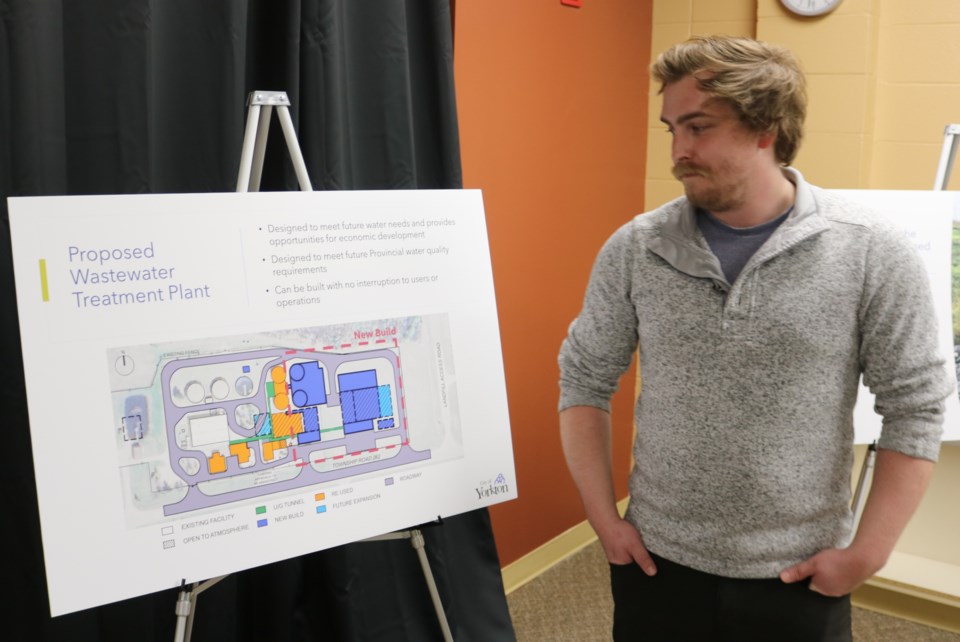
The new facility is being designed to meet current and future water needs and provides opportunities for economic development, and to meet current and future Provincial water quality requirements.
Councillor Stephanie Ortynysky asked what the life expectancy of the new facility would be.
Depending on when construction is complete Hunt said it should be operational until at least 2050.
Hunt also noted that to complete the design project additional funding must be allocated.
“With pre-design now complete, the project has come within approximately $11,000 of its approved $2,200,000 pre-design budget. Updated cost estimates indicate that detailed design, which includes roughly 41,000 hours of engineering, is now expected to total $9,000,000 rather than the originally approved $5,800,000 which was a cost estimate calculated by administration at the one per cent design stage. Administration will be requesting Council’s approval for this increase later in this report,” he explained.
Council was unanimous in allocating the additional funding up to the $9 million.
The question is also where the funding for the project can be accessed.
“It is also becoming increasingly clear that a project of this magnitude does not fit comfortably within most conventional grant programs available to the City,” said Hunt.
To address the funding concern Council unanimously approved authorizing administration to seek and retain a qualified organization to lobby the Federal Government for funding to construct the Water Pollution Control Plant Renewal Project at a maximum cost of $144,000, to be funded from Utility Reserves.
The existing plant was built in the early 1950s and benefited from major upgrades in 1979 and in the late 1980s.
Comments